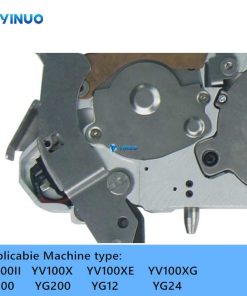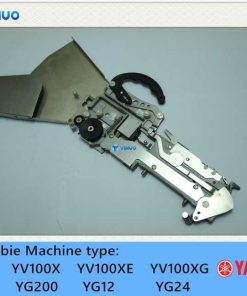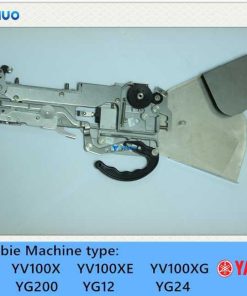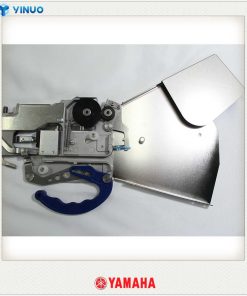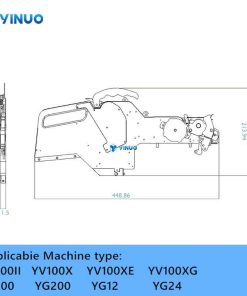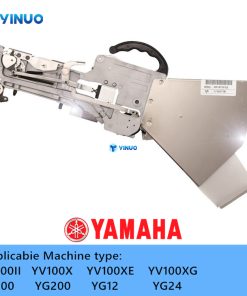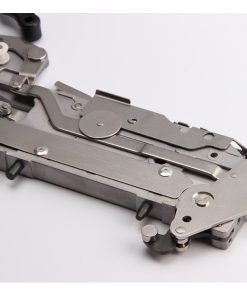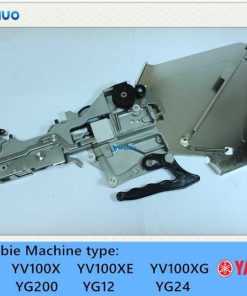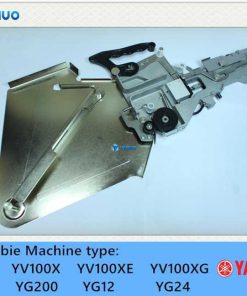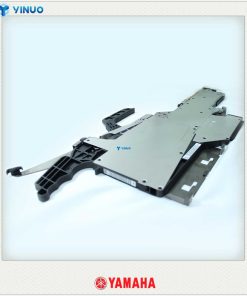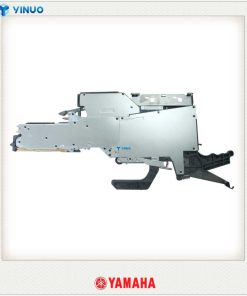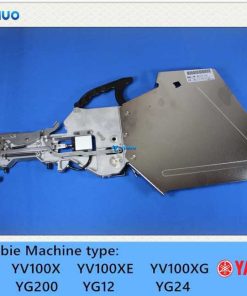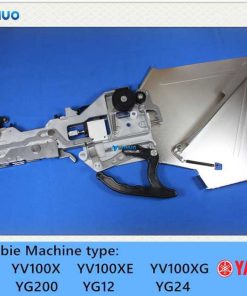

A tubular feeder with automatic lead forming is a device used to transport tubular packaged components. It not only transports the tubular packaged components but also straightens and shapes the component leads. The feeder uses a pusher and airflow mechanism to deliver the component from the tube to the lead forming station. At this station, mechanical dies bend, straighten, or cut the leads to the precise spacing and length required for the PCB. The formed component then reaches the pick-up position, where it can be directly mounted onto the circuit board by the insertion head.
Key Features
The feeder combines tube feeding and lead forming into a single unit — components exit the tube, pass through a forming station with interchangeable dies, and arrive at the pick position with leads straightened, bent, and cut to PCB specifications. This eliminates the off-line lead-forming machine (5,000−5,000−12,000) and its dedicated operator that traditional THT lines require — where components must be formed on a standalone machine before loading into the feeder. A push-bar pushes each component from the tube through a pneumatic air-blow pipeline to the pick position, delivering one component every 0.3-0.5 seconds synchronized with the insertion head — while a fiber-optic sensor verifies component presence and lead alignment at every cycle, keeping insertion failure below 0.5%.
What Does the Lead Forming Do?
Through-hole components arrive from the supplier with straight, long leads. Before insertion, the leads must be:
- Straightened — factory leads are often slightly bent from tube packing
- Formed — bent to the correct pitch (2.54mm, 5.08mm, etc.) to match the PCB holes
- Cut — trimmed to the correct insertion length
| Lead Forming Operation | What It Does | Typical Components |
| Straightening | Corrects bent/twisted leads from tube packing | DIP ICs, transistors |
| Bend-forming | Forms leads to required pitch and bend angle | Radial capacitors, transistors |
| Cut-to-length | Trims leads to correct insertion depth | DIP ICs, axial components |
| Stand-off forming | Creates a gap between component body and PCB | Radial capacitors, resistors |
Technical Specifications
| Component Type | Package | Lead Pitch (Standard) | Forming Required |
| DIP ICs | DIP-8 to DIP-40 | 2.54mm | Straighten + cut-to-length |
| Radial Capacitors | Diameter 5-13mm | 2.5-7.5mm | Straighten + bend-form + cut |
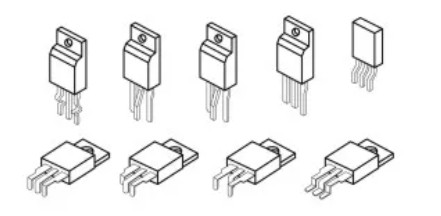
| Transistors | TO-92, TO-220 | 1.27-2.54mm | Straighten + bend-form |
| Axial Components | Resistors, diodes, inductors | 5-15mm | Straighten + bend + trim |
| Pin Headers | Single/double row | 2.54mm | Straighten + cut-to-length |
| LEDs (THT) | 3mm, 5mm, rectangular | 2.54mm | Straighten + stand-off form |
| Crystal Oscillators | HC-49, HC-49S | 4.88mm | Straighten + form |
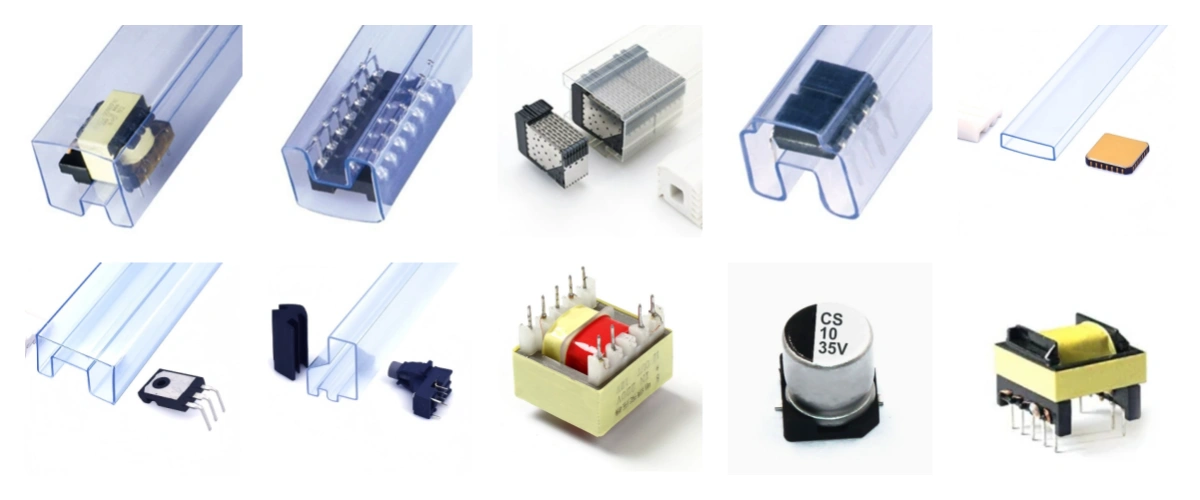
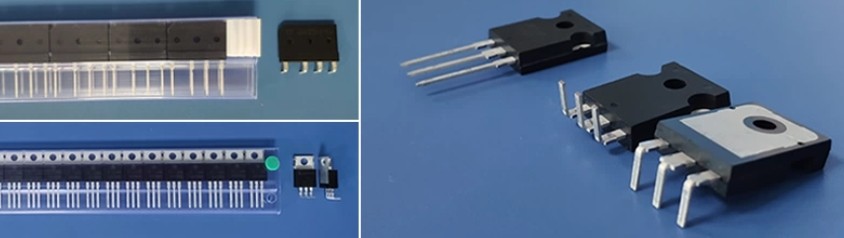
Not Just Feeders. Nozzles, Too — Custom-Made for Your Components.
Standard nozzles struggle with odd-form parts: vacuum leaks, dropped picks, pick-fail rates above 5%. Send us your component samples. We’ll machine a nozzle matched to your part’s geometry — ceramic, tungsten carbide, or rubber — and dial the pick-fail rate below 0.5%.
Feeders and nozzles ship together. 2–4 weeks, one delivery, one freight charge.

FAQ
Q: Are you a factory or a trading company?
A: Your feeder, from requirements analysis and prototype making to mass production, is all completed in Shenzhen—no middlemen involved. We customize according to your machine model and component specifications, and manually cut the bowl rail and rail adapter according to the sample parts you provide. You can request a video visit to the factory or send samples for testing at any time.
Q: Which SMT brands do you support?
A: ASM SIPLACE, YAMAHA, FUJI, Panasonic, JUKI, Samsung. We have corresponding rail adapters for most mainstream brands. If your machine brand is not listed, please send us your machine model, and we will confirm compatibility within 24 hours.
Q: What is the lead time for customized feeders?
A: Tag feeders and tube feeders: 2-4 weeks; Vibratory feeder feeders (requires customized bowl rails): 5-7 weeks. Samples: 5-7 working days. Rush orders can be compressed to 2 weeks (additional rush fee).
Q: What are the payment terms?
A: 30% deposit, 70% due before shipment. T/T wire transfer and L/C are accepted. Monthly settlement is negotiable for existing customers.
Q: What is the minimum order quantity?
A: 1 unit. Customized feeders do not accept large-volume orders. You will need to place a bulk order after you are satisfied with one sample unit for testing.
Q: Who are your main clients?
A: Huawei, Foxconn, Flex, BYD, Luxshare, Delta Electronics, Continental, and Pegatron. These clients use our feeders in their SMT production lines for consumer electronics, automotive electronics, and communication equipment.
Q: What if there are quality problems?
A: 12-month free warranty. Replacement parts or feeders will be shipped within 3 business days (DHL/FedEx express). We will test the feeders on-machine and record a video before shipment. Shipment will only proceed after the customer confirms satisfaction.